
Gerard Spooner and the Scottish Shepherds on Exmoor
During The Friend’s first major project on Hoar Oak Cottage, funded by Heritage Lottery in 2011, an interesting newspaper article was found. On the 10th of June 1852, the North Devon Journal published a report on what seems to have been considered a highly unusual occurrence in Ilfracombe. It was the arrival of 1100 Scottish sheep and a handful of shepherds on a large steam schooner, the SS Glendower, from the Isle of Skye. The original version of the North Devon Journal is slightly damaged as can be seen on the digital copy below. Nonetheless, it is possible to create a transcript for ease of reading. Note: words shown in italics and ??? are a ‘best guess’ for the unreadable print in the damaged part of the newspaper.

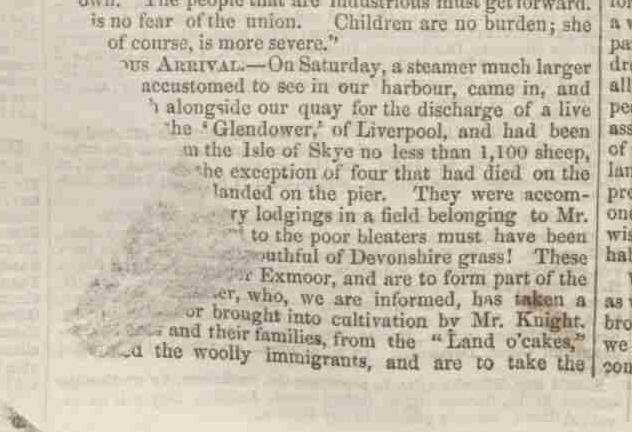
Transcription
CURIOUS ARRIVAL – On Saturday, a steamer much larger than we are accustomed to see in our harbour came in and berthed alongside our quay for the discharge of a live ‘cargo?’ The ‘Glendower’ of Liverpool and had been carrying from the Isle of Skye no less than 1,100 sheep, with the exception of four that had died on the journey’ ‘They’ were landed on the pier. They were accommodated in ?????? lodgings in a field belonging to Mr.?????. ????? to the poor bleaters must have been to be given a mouthful of Devonshire grass! These sheep are meant for Exmoor and are to form part of the herd of Mr Spooner, who, we are informed, has taken a property brought into cultivation by Mr. Knight. The shepherds and their families, from the “Land o’cakes’ and the woolly immigrants, and are to take the future oversight of them; the whole affair is to be conducted on a system that may put a wrinkle or two into the horn of the southerners. What a pity but that, instead of eleven hundred sheep, they had been eleven hundred human visitors with plenty of money in their pockets and resolved to stay here the next six months.
This newspaper article introduces Gerard Spooner, the owner of the sheep and the employer of the shepherds on board the Glendower. The port of departure is the Isle of Skye, and some published commentators have assumed Gerard Spooner was a Scot. See for example: Orwin and Sellick (1929) pp93; Burton RA (1989) pp252; Eardley-Wilmot H (1990) pp149. In fact, Gerard Spooner was born in 1823 in Elmdon, Warwickshire with links into important ecclesiastical families, landed gentry and agriculturalists. How he came to be in Scotland is not known but in 1849, we find him at Easter Ross in the north of Scotland and is mentioned in the Inverness Courier in a list of local farmers and landowners who had been granted licences to shoot game. At this time, in the 19th century, the Scottish Clearances were having significant impacts on the sheep trade with the new owners of enclosed land selling both land and sheep and the displaced shepherds seeking new homes and jobs. Details of this story can be found in Alexander Fenton (1987) Country Life in Scotland, Our Rural Past which can be read free, online at the Internet Archive. Link: https://archive.org/details/countrylifeinsco0000fent/mode/2up
Although the clearances represented terrible losses and changed life circumstances for the agricultural poor in Scotland, they also provided commercial opportunities for others. Gerard Spooner and his brother, Lucius, seem to have been involved in agricultural ‘entrepreneurship’ – Lucius in promoting the trade in shipping that great Victorian fertiliser – guano – from South America to Scotland; Gerard in buying, selling and transporting sheep from the Scottish Borders and islands such as Skye and Mull. The North Devon Journal article from June 1852 captures Spooner undertaking precisely this activity. But this transaction was linked to a much bigger commitment that Spooner was making to Exmoor.
In 1818 John Knight, a wealthy industrialist and MP for Worcestershire, purchased the Royal Forest of Exmoor from the Crown Estates. He set about the enclosure and reclamation of his new ‘Exmoor Estate’ which he ran in the manner of, what some have described as, a ‘Demesne’ where all the land is retained and managed by the owner of the estate for his own use. For a variety of reasons, including financial and health challenges, John Knight soon retired to Italy with his wife and handed the running of the Exmoor Estate over to his son Frederic Knight. John Knight died in Italy in 1850. Frederic Knight moved away from the ‘Demesne’ approach to farming and introduced what has been called ‘Landlord and Tenant’ farming based on ‘Improving Tenancies’ which Burton SH (1969) pp43 helpfully summarises as follows. The improving tenancies involved:
…..very low rents for the first four years, rising each four years thereafter until the twenty-year leases expired. The leases also provided for compensation to tenants for durable improvements made at their own expense.
For more details consult Orwin and Sellick (1929 rev: 1970).
How Gerard Spooner came to hear about the Exmoor tenancies is not known. He moved in the right socio-economic and familial circles to have possibly heard about Knight’s Improving Tenancies through dinner table or business meeting conversations or at family events.
Spooner’s great grandmother was Anne Knight (1708-1783) who was one of the younger sisters of Edward Knight (1699-1780) who was the great grandfather of Frederic Winn Knight. So Gerard Spooner and Frederic Knight were 3rd cousins. Their grandfathers were 1st cousins. So perhaps not a terribly close link, but a family link all the same. It is interesting to note that three of the Scottish shepherds at Hoar Oak Cottage were either 1st or 3rd cousins and another Johnstone cousin, William, ran the nearby Badgeworthy herding – all descended from John and Janet Johnstone who were shepherds at Greenburn near Muirkirk in Ayrshire. Its interesting to speculate on the role that family links, and the word of mouth that goes with them, seem to have potentially played in the Knight’s sheep experiment on Exmoor.
But Gerard Spooner may simply have seen one of the many adverts placed in newspapers and agricultural journals such as the Mark Lane Express – a London based agricultural journal founded in 1832 and published weekly. The advert below, from the Lincolnshire and East Midlands newspapers in August 1849, is recorded in Orwin and Sellick (1970):
Farms to Let upon Improved Principles
Mr Robert Smith begs to inform the Public that he has two Farms to Let upon the forest of Exmoor, the property of F W Knight Esq., MP, one consists of 740 acres, the other of 1000 acres. Also several smaller Farms, the property of other noblemen varying in size for 100 to 600 acres.
Emmetts Grange, South Moulton, 14 August 1849
Note 1: Robert Smith was a well known ‘agricultural improver’ brought in from Lincolnshire to be Frederic Knight’s Land Agent.
Note 2: it is not clear who the ‘other noblemen’ may be – perhaps Smith was also acting on behalf of other Exmoor landowners seeking tenants.
Note 3: a similar advert was place in 1850, again in Lincolnshire and Midland’s newspapers, and Orwin and Sellick (1970) record that both adverts attracted tenants from Lincolnshire, Leicestershire, Derbyshire, Dorset but no one from North Devon.
The North Devon Journal and the Knight correspondence archive record Gerard Spooner arriving on Exmoor in 1852 and taking on the Wintershead Farm tenancy. In 1854, he travels to Ireland and marries Mary Katherine Boland. They both returned to live full time at Wintershead where they had three children. The Knight correspondence, (recently acquired and now lodged in the Somerset Heritage Centre Respository https://somerset-cat.swheritage.org.uk/ Reference No. A/EJM), includes letters to do with Gerard Spooner taking the tenancy of Wintershead Farm, some of his successes and trials with running Wintershead, the challenges of delivering on the requirements of the ‘improving tenancy’ and ultimately his decision to leave. By 1858, correspondence between Robert Smith, Frederic Knight and Gerard Spooner is a bit tetchy and covers the departure of Spooner off Exmoor and the temporary handing over of Wintershead to William Scott, who was one of the shepherds arriving on the SS Glendower in 1852 – according to Burton (1980).
An interesting sidenote here concerns a letter in the Knight correspondence archive dated May 15th,1852 when Land Agent Robert Smith writes to Frederic Knight to say:
Sir,
Mr Spooner’s sheep, 3 shepherds, 2 drainers and 7 children are to arrive about the 4th of June.
I am sir [etc]
Robert Smith
If, as Burton suggests, William Scott arrived on the SSGlendower then four of the seven children could be his. The 1871 census tells us that in 1852, his children would have been Thomas 12, William 10, Margaret 6 and baby Jennet all born in Scotland. What is intriguing is there being no mention of any women arriving on the SSGlendower but Scott’s four children are likely to be accompanied by their mother Margaret. Perhaps one or more of the other two shepherds or drainers were accompanied by a wife and children. Perhaps, as is often the case, these women who travelled from Scotland to Devon on a schooner with 1100 sheep and 7 children including a tiny baby have been ‘lost’ or ‘ignored’ by history. A little mystery to follow up.
When, in 1858, Gerard Spooner gave up the Wintershead tenancy we learn that he embarked on another sheep farming ‘enterprise’. On the 12th of February 1860, Gerard Spooner departed for New Zealand on board the Gananoque sailing from Gravesend. He arrived in New Zealand on the 9th of May 1860. It’s uncertain where his wife Mary and the three children born on Exmoor were at this time. Possibly she was with her parents or other family as she had a further child. But in 1861, Mary and the children also sailed for New Zealand on board the SS Cashmere accompanied by Mary’s brother, Thomas Boland, and two of her sisters.
It is understood that Spooner had acquired land to establish a sheep station and build a house at Popotunos between Dunedin and Invercargill. The property was named ‘Elmdon’ – after the Spooner Estate in England – and Gerard and Mary seem to have made a good living there as well as having another five children. They left in 1883 and moved to Dunedin. In 1887, Gerard and Mary moved to Napier where their fourth son, Edward Wilberforce Spooner, and other family members lived. Gerard Spooner died on 9th November 1907 and is buried in Sydenham Cemetery, Sydenham, Christchurch, New Zealand. His gravestone records that his wife Mary died ‘soon after’ but in fact she died on 26th June 1910 and she is buried in Remura Cemetery, Auckland along with two of her daughters, Henrietta Rich and Alice Harman who both died in 1952. Her obituary in the Otago Herald states that Mary Kate Spooner was a ‘well read and accomplished woman’.
Some of the information above, to do with the Spooners in New Zealand, has been gleaned from Ancestry so a degree of caution is advised in terms of its accuracy. It would, however, be fascinating to learn of any descendants of Gerard and Mary Spooner in New Zealand and fill in some of the details. Please get in touch if you have information to share. Email: info@hoaroakcottage.org
The influence of Gerard Spooner on sheepfarming on Exmoor in the second half of the 19th century has been acknowledged. Orwin and Sellick (1970) state:
‘to Gerard Spooner belongs the credit of having introduced a system of farming on the Forest which was one day to be its most permanent and important feature. His farm was ‘occupied as a Scottish sheep farm, with flocks of Cheviots and Black-face sheep’ and he endeavoured to ‘introduce the Scotch system of selling of his lambs every year in the autumn’ pp94. He used his knowledge of sheep rearing in Scotland and concentrated on ‘intensifying (Exmoor’s) long established capacity to carry stock’ by growing roots and grasses and oats only as winter feed for horses and cattle. pp95
Roger A Burton (1989) also recognises Spooner’s influence on Frederic Knight’s ‘sheep ranching experiment’, started in the 1870s. He says:
‘the reintroduction of the Cheviot and Blackface sheep took place some 20 years after Gerard Spooner had come down from Scotland in 1852 to take Wintershead, bringing with him his own shepherd, William Scott, and a mixed flock of Cheviots and Blackfaces. Although the time was not right (in 1852) for his style of sheep ranching – or the acceptance of those breeds locally – Spooner proved during the six years he remained on Exmoor that given the right conditions his way of farming could be made to pay, and when, in the late 1860s Frederic Knight’s farms began to come in hand it was this method of sheep ranching that was decided upon to make the best use of the land.’ pp112 and 113.
The influence of Gerard Spooner on part of the history of Hoar Oak Cottage must also be acknowledged. The sheep ranching experiment he is recognised as responsible for led to many Scottish shepherds, often with wives and children, migrating to Exmoor. Some to stay permanently and some to ‘come and go’. The four Scots shepherds employed to run the Hoar Oak herding and live at Hoar Oak Cottage included three cousins from Lanarkshire – William Davidson (arrived 1870), John Renwick (1879) and James Maxwell Johnstone (1885). Another Johnstone cousin, William, was not far away running the Badgeworthy herding and Archie Jackson was the last Scottish incumbent at Hoar Oak (1905). James Johnstone died at Hoar Oak Cottage and his wife and family of 13 children stayed in and around Exmoor. William Davidson, John Renwick and Archie Jackson all returned to Scotland. So too did William Johnstone.
The Friends of Hoar Oak Cottage charity was founded by descendants of James and William Johnstone and has, as a consequence, always had a keen interest in the story of the Scottish shepherds on Exmoor. This dive into the story of Gerard Spooner on Exmoor helps to explain why these Scottish families migrated to Exmoor during the second half of the 19th century. During this ‘dive’ other intriguing lines of enquiry and information have been identified. As ever, research throws up more questions that need to be answered and it is hoped that, over time, these new research avenues will be shared with followers of The Friends of Hoar Oak Cottage.
Image of North Devon Journal report 1852 reproduced with kind permission of The British Newspaper Archive (www.britishnewspaperarchive.co.uk